
Shade Grasses i.e. sedges– The Final Frontier in Shade Gardening!
Nyle Zikmund, Anoka County Extension Master Gardener
When your garden includes shade, and you have tried numerous shade perennials, and grasses; all resulting in momentary bliss – but then winter comes and spring follows, and nothing comes up! This is the time to try some sedges. Sedges and grasses are similar but are in fact in two different families. Grasses are in the Graminaceae family and have nodes from the top to the ground, sedges are in the Cyperaceae family and have edges. A detailed plant anatomy dissertation is lengthy and very technical. The practically important details are that due to this anatomical difference, most sedges tolerate shade better than grasses along with sedges ability to tolerate; and sometimes prosper in a wide range of soils and soil moisture conditions. Similarly, the plant anatomy of shade perennials varies widely from plant to plant thus impossible to detail all in this article. The point of this article assumes attempts with shade perennials have failed in your situation and where those conditions exist; sedges are a viable alternative. That said, it is still an experiment – you just must try, sometimes planting several kinds. Every garden is different in terms of soil, sun, and water.
This article highlights four sedges in which the author has experienced success when others (many) failed; shade sedges and shade perennials. Those four are - Palm, Ivory, Curly Styled Wood, and Mondo Grass. They are all natives, have some kind of flower/seed pod, and will grow in those tough shade spots. They also provide additional value in their contrast to leafy perennials. Pictured is Mondo Grass – which produces a fantastic brilliant white flower.
This area receives minimal filtered morning sun for a couple hours and has no irrigation. Mondo Grass takes a year or two to fully establish, spreads slowly, but is easy to manage. It will tolerate 2 to 3 hours of direct sun and flowers more robustly in that environment. It is a very durable sedge.
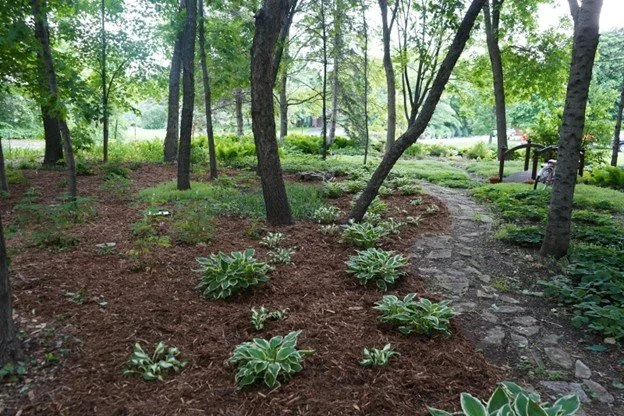
The other three, Curly, Ivory, and Palm are all “clumpers”! My term for exactly that, they grow into a clump and need to be divided to spread. As a rule, full grown Ivory, and Curly sedge mature at 6 to 12 inches in three to four years. Palm sedge can mature from 1 to 3 feet in that same time! I have found it best to wait until full maturity to divide, but only if you’re looking to fill in more space. Of the four, my experience is that Curly and Palm sedge have worked in the most difficult spots – defined as those where nothing else has succeeded – including Ivory Sedge and Mondo Grass. While all four have shown remarkable success, Ivory and Curly are more robust in my specific situation/conditions. The soil conditions are all the same (compost is added when planting and fertilizer is applied in April and August), all have similar irrigation removing that variable from the equation, and all have the same sun exposure – no direct sun. At most they get 1 to 2 hours of either heavily dappled or indirect filtered light. Other than Hosta’s, everything else failed in these specific examples– ajuga, columbine, pachysandra, and other/similar shade perennials.
Like any plant (perennial or annual), soil conditions and water are force multipliers and sedges are more responsive when time is taken to ensure soil conditions are optimal. If unsure, the University of Minnesota performs soil testing for a nominal fee of about $20 and provides you with a written report detailing the soil make up, but more importantly, recommendations on what is needed. Match their recommendation with the details that are provided on the plant tag. When prepping the site for planting, as you dig/excavate the hole, adding in organic matter (compost) along with the soil recommendations if any, will dramatically increase the success and vibrancy of any plant. Fertilizing with a 10-10-10 in mid-April and then again in August results in much greater success and performance. You should see results in the first year but by year three, you will have a very nice “grassy” and thus classy – shade garden!